Accessible seating tickets are for people whose disability requires the features of those seats: wheelchair spaces, companion seats, and seats built for easier access. Under U.S. federal rules you can't be asked for a doctor's note to buy them. The seats are meant for the people who need them and the people they bring. If that is you, or you are buying for someone it is, the job is to find the right section, bring your companions along, and confirm the details before the event. At Nashville Ticket Brokers, our 100% money-back guarantee covers tickets arriving before the event and being valid for entry.
TL;DR
- Accessible seats are for people whose disability requires their features, and for the companions who sit with them. A simple preference for the location is not enough.
- Federal rules say a venue may not require proof of disability such as a doctor's note before selling accessible seating. It may ask a basic question about need.
- You can usually bring companions. Federal rules call for up to three additional contiguous seats in the same row when they exist at purchase.
- Check the listing for the section, row, view, and features. Then confirm your needs with the venue's accessibility contact before the event.
- If a person with a disability can't attend, they may transfer an accessible ticket to anyone, under the federal rule on transfers.
Table of Contents
- What accessible seating tickets actually are
- Who can use accessible seating tickets
- Do you need proof of disability?
- Booking a group: accessible seats plus companions
- What if someone in the group can no longer attend?
- When venues release accessible seats to the public
- What to check in any accessible seating listing
- Planning around Nashville events
- Find tickets for your group
- FAQ
- Sources
What accessible seating tickets actually are
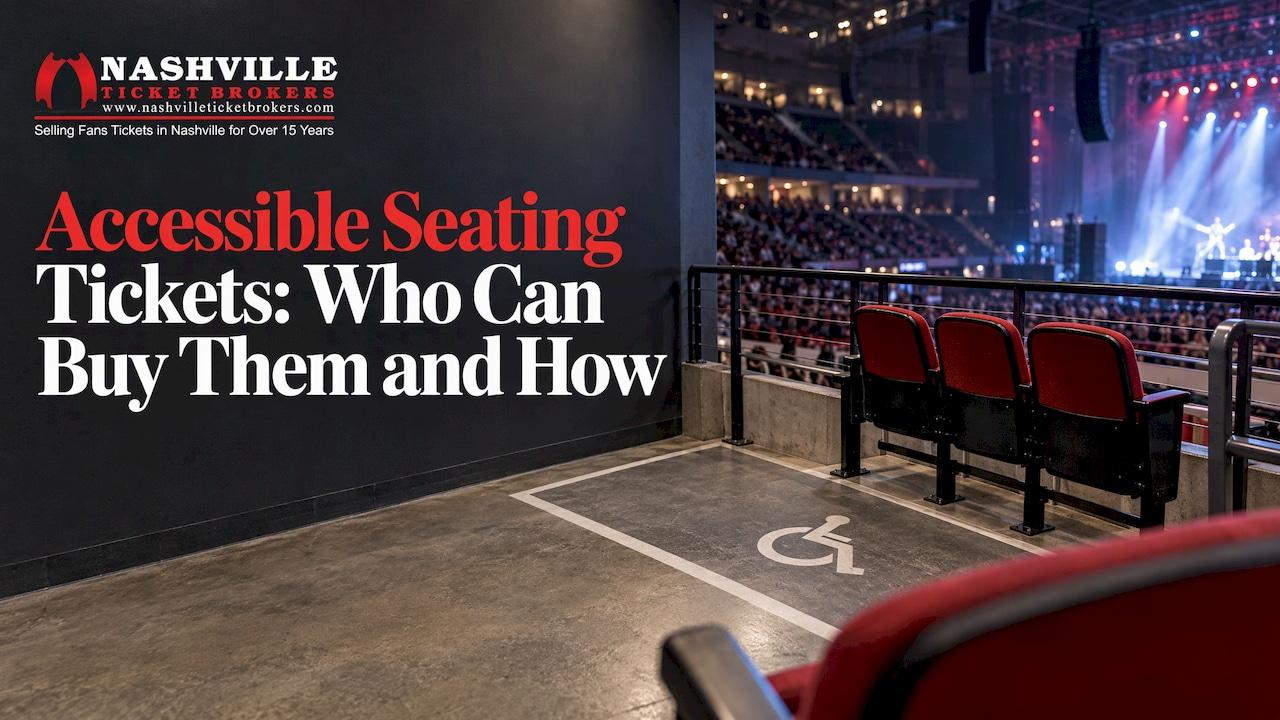
Accessible seating covers a few different things. The most familiar is the wheelchair space: a spot on the floor or a platform designed so a wheelchair can be parked with a clear view. Next to it sit companion seats, regular seats placed beside the space so the group stays together. Some venues also offer designated aisle seats and seats with extra legroom or fewer stairs. The Ohio agency for people with disabilities describes accessible seating as wheelchair spaces, companion seating, and designated aisle seats, which matches how most arenas, theaters, and stadiums set it up.
The federal government treats these seats as a special inventory because there are far fewer of them than regular seats. That is why the rules around who buys them are firmer than for a standard ticket.
What "ADA wheelchair accessible only" means on a listing
You'll sometimes see a ticket labeled "ADA" or "wheelchair accessible only." ADA stands for the Americans with Disabilities Act, the federal civil rights law that governs how venues sell and manage this kind of seating. The label means the space was designed for a wheelchair. According to the Department of Justice, accessible seats are spaces specifically designed for wheelchairs, and they may be bought by people with mobility disabilities, by people whose disability requires the seats' features, or by someone buying on their behalf.
Two practical points follow:
- If you use a wheelchair or scooter, or need the specific features of an accessible space, these tickets are meant for you.
- If you are buying for a parent, friend, or family member who needs them, that is explicitly allowed. You don't have to be the person with the disability to place the order.
Who can use accessible seating tickets
The federal answer is straightforward. Accessible seats are intended for people with disabilities and the people accompanying them. A preference for a flat entrance, a quick exit, or an aisle for convenience does not qualify on its own. The Seahawks' ticket terms say accessible seats are intended for fans with disabilities and their companions, which is typical of how teams and venues across the country word it.
That clarity helps you. Because the seats are protected for people who need them, they are there when someone in your group does need them, and you can plan around them with some confidence.
What if you buy accessible seats and don't need them?
Venues take misuse seriously, and they say so in writing. Here is what several of them state:
- Arizona State's athletics department says fraudulent accessible-seat purchases can lead to relocation, expulsion from the event, or loss of future access.
- The University of Texas says it may investigate suspected misuse and, in appropriate cases, cancel an improper order or relocate patrons who do not need accessible seating.
- The Seahawks reserve the right to relocate holders who do not require accessible seating, without refund or other remedy.
The federal rule allows venues to look into suspected fraud and to warn purchasers that relocation may result. The takeaway is simple: buy accessible seats only if you or someone in your group needs them. Everyone else will have an easier night in a standard section.
Do you need proof of disability?
No. This surprises many buyers. The federal ticketing rule says a venue may not demand proof such as a doctor's note before selling accessible seating. What it can do is ask. For a single event, a venue may ask whether the buyer, or the person the tickets are for, has a disability that requires accessible seating. For a series of events or season tickets, it may request a written statement saying so. Both points are in 28 CFR § 35.138 and the Justice Department's ticket sales guidance.
In practice, you'll see this in a few forms:
- A checkout question. LA28's U.S. ticketing guidance says supporting documents need not be provided at purchase, but the buyer attests at checkout that someone in the group has a disability requiring accessible seating.
- Buy first, then request accommodations. The Anthem in Washington, D.C. states that no proof of disability is required to request accessible seating, and it asks guests to purchase tickets before requesting ADA accommodations.
- A written statement for series tickets. If you are buying a package, expect to sign a short attestation.
In every case, answer honestly. The attestation is the venue's tool for keeping these seats with the people who need them.
Booking a group: accessible seats plus companions
Group seating is where most of the confusion sits, so it deserves a careful look. The goal is simple: the person who needs the wheelchair space shouldn't end up at one end of the arena while everyone else sits at the other.
How many companions can sit with you
For a wheelchair space, federal rules require the venue to make up to three additional contiguous seats in the same row available, when those seats exist at the time of purchase. Those seats may also be wheelchair spaces. That rule appears in 28 CFR § 35.138. Venues often restate it in their own policies. Fiserv Forum, for instance, permits a guest who requires accessible seating to buy up to three companion seats in the same accessible row, subject to availability, and advises buying in advance.

Three companions plus the person using the space makes a party of four. A larger group, say eight friends going to a game, needs a plan.
What if contiguous seats aren't available
The Justice Department says that if seats right beside the accessible space are gone, the venue must offer seats as close as possible. It may charge the price that applies to those alternative seats and doesn't have to move them into a different price category. So the group may be near each other rather than side by side.
For bigger groups, the federal guidance says that if a group has to be divided, wheelchair users should not be isolated from the group. The ADA National Network's ticketing guidance makes the same point: groups should sit together whenever possible.
Reserved seating versus general admission
The format of the show changes how this works. The Anthem explains that fully seated shows have limited ADA inventory. For general-admission shows, it reserves accommodation space, guarantees one companion seat until the list fills, and tries to place additional party members nearby, subject to space. Reading that policy before a general-admission concert tells you what to expect: for those shows, early contact matters more than the exact spot.
A group-booking routine that works
- Count your party. Write down who needs a wheelchair space, who needs companion seating, and who is simply joining.
- Pick the event and section first. Decide whether you want the floor, the lower bowl, or a mezzanine platform. Accessible spaces are often placed at several levels and price points.
- Check availability for the whole group at once. If you can only find two seats together, ask the venue's accessibility contact about nearby companion options before you buy.
- Buy early. Accessible inventory is small. Waiting for a sold-out show to open up means waiting on a short list.
- Confirm with the venue. Once your order is placed, contact the venue's accessibility office to confirm your needs, entrances, and any pre-event arrangements.
If you are planning an outing that includes several types of ticketed activity, the same habit of checking access details up front applies. A wheelchair accessible Seine cruise guide shows how much detail you can expect to find when you plan ahead for boarding, space, and companions.
What if someone in the group can no longer attend?
Plans change. A friend gets sick, a work trip pops up, and suddenly your four-seat block is three. The federal rule on transfers is on your side here. When a venue allows ticket transfers at all, it must give accessible-ticket holders the same right. According to the Justice Department, a person with a disability who holds an accessible ticket may transfer it to anyone, including someone without a disability, and the venue cannot require the transfer to go only to another person with a disability.
Two things to keep in mind:
- A companion's seat is tied to the party. If the person using the wheelchair space can't go, ask the venue how it handles the remaining companion seats before the event.
- Policies on transfers and refunds are set by the venue and the ticketing terms of the event. Read the terms attached to your tickets, and contact the venue's accessibility office early if your group changes.
When venues release accessible seats to the public
If you've noticed accessible seats appearing in general inventory late in the sales cycle, there is a reason. Federal rules allow a venue to release unsold accessible seats in specific situations: after all non-accessible seats are sold, or after all non-accessible seats in a given area or price category are sold. A venue is not required to release them. The Justice Department explains the three release circumstances in its guidance, and the ADA National Network lists the same ones.
There is a related protection for season and series buyers: accessible season seats that are released to the general public must not renew automatically in a way that blocks future access for people who need them.
For you as a buyer, this means two things. First, late availability is real for some events, so it is worth checking back. Second, a released accessible seat is still an accessible seat. Buy it for the features it offers, and the group it fits.

What to check in any accessible seating listing
The Justice Department says that information about accessible seats must describe their features, location, price, view, and availability in enough detail for buyers to judge whether they meet their needs. That is your checklist. Before you buy, look for:
- Seat type. Wheelchair space, companion seat, aisle seat, or a seat with a transfer option.
- Section, row, and level. Is it floor, lower bowl, or upper level? How close is it to the entrance, elevator, or restroom?
- The view. Is the sightline clear for someone seated in a wheelchair? A railing or a standing crowd in front can change what you see. Our guide on obstructed view seats explains how to read view notes in a listing, and the same questions apply to accessible spaces.
- Price. Accessible tickets are sold on the same terms, in the same sales stages, through the same outlets as other tickets under federal rules. You should not be paying a surcharge simply for needing the seat. The rule is in 28 CFR § 35.138.
- Companion options. How many seats sit beside the space, and are they in the same row?
- Delivery and timing. Make sure the tickets arrive in time for you to confirm accessibility details with the venue.
If any of those answers isn't in the listing, ask before you buy rather than after.
Planning around Nashville events
Nashville has a full calendar: country and pop shows, NFL and NBA-level sports, UFC cards, and touring theater. Each format sets its own rhythm for accessible seating.
- Concerts. Reserved-seat shows have a fixed number of spaces per section. General-admission shows work through accommodation lists. Read the policy for the specific venue.
- Football and basketball. Large stadiums and arenas tend to place accessible spaces at several levels, so you can often choose a view that suits you.
- Theater. Smaller houses have fewer spaces, so book as soon as dates go on sale.
Whatever the format, the sequence is the same: choose the event, choose the section, count the party, buy early, and confirm with the venue's accessibility office. You can browse concerts, sports, and theater in one place and compare the listings that fit your group.
What we tell fans who need accessible seats
Most of the questions we hear about accessible seating come down to one worry: will the ticket work when we get to the gate? That is the same worry we built our promise around. Our 100% money-back guarantee exists so that tickets arrive before the event and are valid for entry.
For a fan who needs a wheelchair space or a companion seat, that matters even more. A last-minute problem can't be fixed by squeezing into a different row. So we encourage you to plan early, read the listing details closely, and confirm your needs with the venue's accessibility office as soon as your order is placed.
Sold-out shows are where a resale marketplace helps most. When the box office has nothing left, fans still need a way to get their group to the game or the concert together. We want that to be simple, and we want you to feel assured when you check out.
Capital
Find tickets for your group
Nashville Ticket Brokers is a resale marketplace for concerts, sports, theater, and family shows, including popular categories such as NFL tickets, NBA tickets, UFC tickets, country music tickets, and pop and rock tickets. When a show is sold out at the box office, you can look for seats for your whole group here. Every order is backed by our 100% money-back guarantee that tickets arrive before the event and are valid for entry. Start from the Nashville Ticket Brokers home page and pick your event.

Once your order is in, take the next step the same day: contact the venue's accessibility office to confirm your seat type, entrance, and companion arrangements.
FAQ
What does "ADA wheelchair accessible only" mean?
It means the seat is a space designed for a wheelchair, and it is meant for people whose disability requires that feature and for their companions. The Justice Department notes that accessible seats can be bought by people with mobility disabilities, by people whose disability requires the seats' features, or by someone buying for them. Their ticket sales guidance explains the rule in full.
Do I need a doctor's note to buy accessible seating?
No. Federal rules say a venue may not require proof of disability before selling accessible seating. For a single event it may ask whether you or the person you are buying for has a qualifying disability, and for a series it may ask for a written statement. Answer honestly, since venues can investigate suspected misuse.
What happens if I accidentally buy accessible tickets and don't need them?
Venue policies differ, but several say they may relocate holders who don't need accessible seating, and some may cancel the order. The Seahawks' terms, for example, reserve the right to relocate holders without a refund. If you realize the mistake, contact the venue's ticket office as early as you can, before the event.
Can my whole group sit together in accessible seating?
Often, yes. Federal rules call for up to three additional contiguous seats in the same row when they are available at purchase. If those are gone, the venue must offer seats as close as possible. Larger groups may be split, but a wheelchair user should not be isolated from the group.
Can I give my accessible ticket to someone else if I can't go?
If the venue permits transfers, it must give accessible-ticket holders the same right. A person with a disability may transfer an accessible ticket to anyone, including someone without a disability. Check your ticket terms and tell the venue's accessibility office about any change in your party.
Sources
- ADA Requirements: Ticket Sales, ADA.gov
- 28 CFR § 35.138, Ticketing
- Accessibility at The Anthem
- LA28 accessible ticket purchase guidance
- Ticket Policies, ASU Sun Devil Athletics
- Accessible Seating Policies & Procedures, Texas Athletics
- Seahawks Ticket Terms
- Accessibility, Fiserv Forum
- Ticketing, ADA National Network
- Accessible Seating, Opportunities for Ohioans with Disabilities