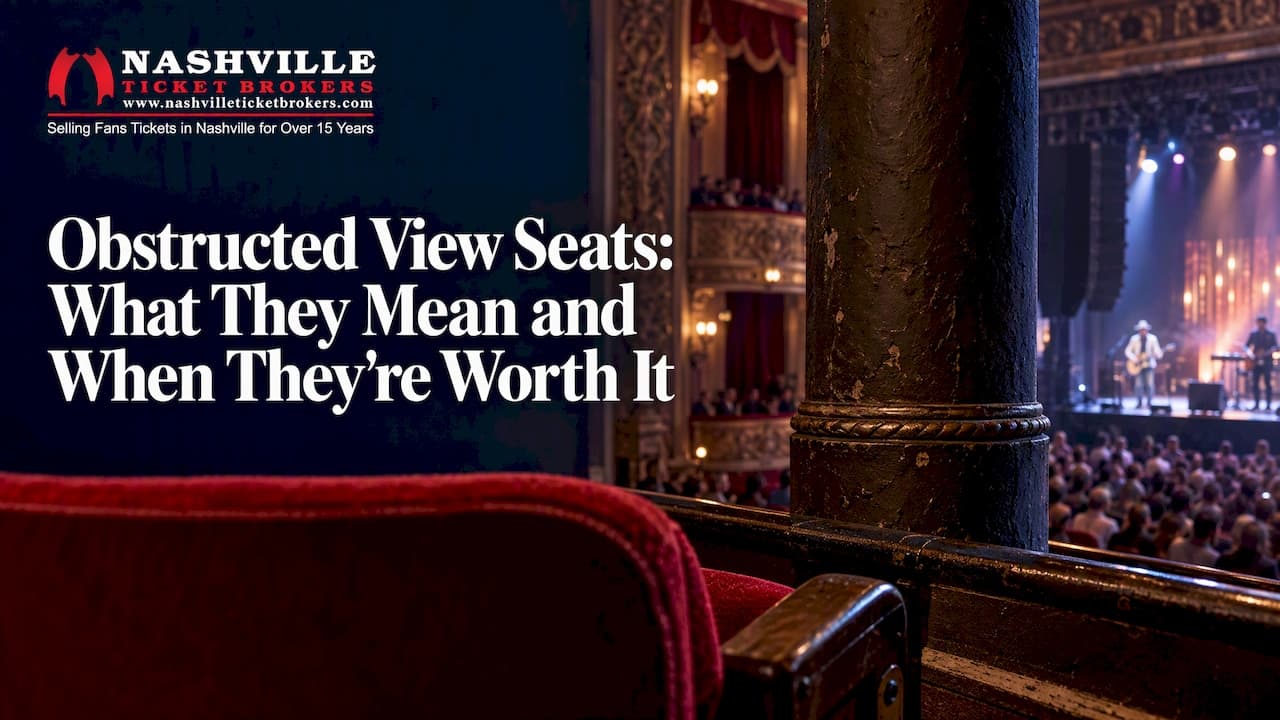
Obstructed view seats are seats where something, usually a pole, rail, speaker tower, sound booth, overhang or camera platform, blocks part of the stage, court, field or screen. You can still get in and still hear everything. You just won't see the whole show from where you sit. Whether that is a bargain or a mistake depends on the venue, the kind of event and how much of the view is actually lost. This guide shows you how to judge that before you pay.
TL;DR
- "Obstructed," "limited" and "partial" view all mean you will miss some of the stage or playing area. "No view" or "listening only" means you will miss most of it.
- A small obstruction at a music show can be a fair trade for a lower price. At an event built around visuals, like a screen-wrapped venue, it usually is not.
- Look up the exact section and row on a seating chart, then check fan photos, because generic charts often leave out overhangs and columns.
- Disclosure rules vary by state. New York, for example, requires obstructed views to be disclosed in resales. Keep your order page and screenshots either way.
- Buy from a seller that backs the ticket. We stand behind every order with a 100% money-back guarantee that tickets arrive before the event and are valid for entry.
Table of Contents
- What "obstructed view" actually means
- Why venues sell these seats at all
- When obstructed view seats are a good deal
- When to skip them
- How to check a seat before you buy
- Know your rights before you click buy
- Obstructed views by event type
- Our perspective on obstructed view seats
- Finding seats that fit your budget and your view
- FAQ
- Sources
What "obstructed view" actually means
The phrase is a catch-all. Sellers and venues use it for anything from a thin support pole that clips one corner of the stage to a seat where you will watch most of the night on a video screen. Three labels cover most of what you will see:
| Label | What it usually means | What to expect |
|---|---|---|
| Limited view / partial view | Part of the stage or playing area is hidden by a structure, an angle or equipment | You see most of the action, but you may lose a corner, a side or the back of the stage |
| Obstructed view | Something sits in the line of sight, such as a post, rail, speaker or camera platform | You lean, shift, or miss moments depending on where the performer stands |
| No view / video view / listening only | The seat has no direct view of the stage | You hear the event and watch screens, which is a different experience entirely |
There is no universal standard. One venue's "limited view" is another's "obstructed." That is why the label should start your research, not end it.
Why venues sell these seats at all
Most older theaters, arenas and halls were built before modern production. Balconies need support columns. Sound and lighting need booths. Touring productions add speaker arrays, video walls and camera positions that did not exist when the seating chart was drawn. Venues sell the affected seats anyway because plenty of fans do not mind, and the price is lower.
The obstruction can also change from show to show. A seat with a clear view for a basketball game can have a stage set in front of it for a concert. A side section that is fine for a solo singer can lose half the stage when the band brings in a large production. The same seat in the same building can be a different purchase on different nights.

When obstructed view seats are a good deal
A common assumption is that an obstructed view always means a ruined night. It does not. Plenty of concertgoers find that being closer to the performers, or sitting at a higher angle, is worth a partly blocked view and a lower price. The tradeoff tends to work in these situations:
- The obstruction is small and static. A single slim pole at the edge of your sightline is easy to lean around. A large speaker stack in front of you is not.
- You came for the sound and the atmosphere. At a country or rock show where the band is the draw, a missed corner of the stage matters less than being in the room.
- The event is sold out and you want in. For a high-demand show, an obstructed seat may be the only way to be there at a price you can manage.
- You are going in a group and splitting the cost. If everyone knows what they are buying, a lower price per seat is a reasonable trade.
- The seat is close. A front-section seat with a pole in the sightline can still beat a clear seat in the last row.
Nashville is a good example. The Ryman Auditorium seats 2,362 in original wooden pews, and guides to the hall point to the front rows of the balcony as some of the best sightlines in the house. Fans looking at the Ryman should still know that poles supporting the balcony block some main-floor views, so a main-floor seat is not automatically a clear one. Also, taller guests seated in front can occasionally obstruct the view in some sections, which no chart will show you.
When to skip them
Some events punish an obstructed seat. Anything built around what you see, rather than who is on stage, is a risk.
The clearest recent example is the Sphere in Las Vegas. During the U2 residency, fans reported that an overhang restricted their view of the huge wraparound screen. According to a venue-focused guide, about 800 seats were affected by an overhang that was not identified on all seating charts at first. The same guide's quick answer on the worst seats points to the sides of the 400 level, where extreme angles distort the screen and strain your neck. The operators later said there was little more they could do for fans who had bought seats with blocked sightlines, which tells you how much the decision rests with the buyer.
Skip or think twice about obstructed seats when:
- The production is visual first: screens, projection, large staging or theater with intricate sets.
- The obstruction sits in the center of your sightline, not at the edge.
- You are buying for a special occasion, such as a birthday, an anniversary or a once-in-a-decade tour.
- The listing says "no view," "video view" or "listening only." Those are not bargain seats with a small catch. They are a different product.
- You are buying for a child or a shorter guest who may not be able to lean or stand to see around the obstruction.
How to check a seat before you buy
This takes ten minutes and prevents most regrets.
- Find the exact section, row and seat range. "Side view" or "limited view" is not enough. Write down the section and row.
- Open the venue's seating chart for that event type. A hockey layout is not a concert layout. End-stage, center-stage and in-the-round configurations change which seats face what.
- Look for the reason in the listing. A good listing says what blocks the view: a pole, a rail, a sound board, a camera platform, the stage set. If it only says "obstructed," ask or look elsewhere.
- Search for fan photos from the same section. Seat-view photo pages and fan forums often show the real sightline. Search the venue name plus the section and the words "overhang," "column" or "pole." These structures are often missing from generic charts.
- Check the tour or production. Set designs, extra speakers and video walls change from tour to tour. A photo from a different show may mislead.
- Compare the discount to what you lose. If the obstructed seat costs a few dollars less than a clear seat in the next section, take the clear seat. If it is substantially cheaper and the block is minor, it may be worth it.
- Check row position. Edge-of-row seats near a pole or rail often have the worst angle. Seats a few places in can be clear. Look at the specific seat numbers when the seller shows them.
Know your rights before you click buy
In the US, disclosure of obstructed views is not governed by one national rule, so protections depend on where the event is. New York is the strongest example. Under Arts and Cultural Affairs Law Section 25.13, promoters and operators must determine and disclose whether a seat has an obstructed view, and that disclosure applies to resales. If you buy for a New York event and the obstruction was not disclosed, a consumer complaint is worth considering. The New York Attorney General's office handles consumer complaints in that state.
Outside the US, enforcement has also happened. In Canada, Consumer Protection B.C. reached an agreement with a major resale platform under which fans who bought undisclosed obstructed-view resale tickets to Taylor Swift's Eras Tour in Vancouver might be eligible for refunds. That shows regulators treat missing disclosure as a real problem, but it is a Canadian case under provincial law and does not apply to a purchase in Tennessee.
What you can do anywhere:
- Screenshot the listing, including the section, row, price and any view notes, before you check out.
- Read the seller's refund and guarantee terms before you buy, not after.
- Contact the seller quickly if the seat description does not match what you were sold. Delay makes problems harder to fix.
- If you live in a state with ticketing laws, check your state attorney general's consumer pages.
If you are not sure how resale protections work, our explainer on verified resale tickets and the 100% money-back guarantee lays out what to look for in any purchase.
Obstructed views by event type
Concerts
Concert obstruction usually comes from side stage angles, production equipment, sound boards and balcony supports. For a single performer with a simple set, a partial block often costs you little. For a band that moves across a wide stage or a show with big video, your seat's angle matters more. Browse concert tickets and compare sections, not just prices. If you are after a country night, the country music tickets page is a good place to start.
Sports
Sports venues rarely have poles in the sightline, but they have their own versions: railings at the front of a section, overhangs above upper-deck rows, and seats behind a goal, basket or net. At a hockey game, glass and stanchions can affect the first rows. At football and basketball games, a camera platform or tunnel entrance can block part of the action. Fighting events add the cage and the angle to the equation, and our UFC seating guide shows how to choose between floor, lower-bowl and upper-level seats. For the full range, see our sports tickets page.
Theater
Theater suffers most from side sections and overhanging balconies. In many houses, the rear orchestra under the balcony lip and the far sides lose parts of the stage, and the top rows of the balcony can lose the front of it. A partial view at a play with a small cast can be fine. A musical with large set pieces, or a show where action happens high or far to the side, can lose scenes. Check theater tickets with the same care you would any other and read the notes on each listing.
Our perspective on obstructed view seats
We are a resale marketplace, so we see how fans actually shop. The pattern is consistent. Buyers do not regret the obstructed seat itself nearly as much as they regret not knowing what they were buying. A pole at the edge of the stage is a minor annoyance when you expected it. It is a ruined night when you did not.

So our advice is plain. Use the discount if the tradeoff suits the event, but treat the label as a question to answer, not a warning to ignore or a deal to grab. Know the section and row. Know what blocks the view. Know whether the show depends on seeing everything. And buy from a marketplace that stands behind the ticket: we offer a 100% money-back guarantee that your tickets arrive before the event and are valid for entry.
That guarantee covers delivery and validity, and you should read the terms at checkout so you understand what it covers. It does not replace doing your own seat research. A valid ticket to a seat with a view you did not check is still a seat you chose.
— Capital
Finding seats that fit your budget and your view
If you want a lower price without gambling on sightlines, you have a few options besides obstructed seats:
- Move up and to the center. A higher seat with a straight-on angle can beat a lower side seat.
- Try the front of the balcony. In many halls, front balcony rows give clear, elevated views at a lower price than the floor.
- Compare weeknights and less popular dates. The same venue and show often cost less on a different night.
- Buy in a pair, not a group. Two seats are easier to place in a clear section than six.
- Look at partial-view listings with a specific reason. A listing that explains what blocks the view lets you judge the risk.
When you are ready to compare real options, you can browse every category from our home page, or go straight to events in sports, concerts and theater. Each listing shows the details you need to compare sections, and our money-back guarantee applies to your order. Here are pages for popular choices: NFL tickets, NBA tickets, UFC tickets and pop and rock tickets.
FAQ
What does obstructed view mean at a concert?
It means something blocks part of your sightline to the stage, such as a pole, rail, speaker tower, sound booth or overhang. You will usually see most of the show but lose some of the stage. The size of the loss depends on the seat and the production, so check the section, row and any notes in the listing.
Are obstructed view seats worth it?
Sometimes. They can be a good value when the block is minor, the seat is close, and you are there mostly for the music. They are a poor choice for visually driven events, special occasions or seats where the block is in the middle of your sightline. Compare the price gap with a clear seat nearby before you decide.
Do sellers have to disclose obstructed views?
It depends on the state. New York law, for one, requires disclosure of obstructed views in sales and resales. Other states have different rules, and some have none specific to views. Whatever your state, save a screenshot of the listing at purchase.
What is the difference between limited view and obstructed view?
There is no universal standard. Limited or partial view usually means an angle or structure hides part of the stage, while obstructed view usually means an object sits in your line of sight. Venues and sellers use the terms differently, so ask what blocks the view rather than relying on the label.
How bad are obstructed seats at the Sphere?
They can be bad because the show is the screen. Fans at the U2 shows reported that an overhang interfered with the view, and a venue guide lists the 400-level sides as the weakest area. If you are going to a screen-based show, pay for a clear sightline.
Sources
- New York Arts and Cultural Affairs Law Section 25.13
- U2 fans claim overhang is ruining Las Vegas Sphere shows, Irish Star
- Worst Seats To Avoid At The Sphere, All About The Sphere
- MSG Sphere outreach after the U2 seat fiasco, Las Vegas Review-Journal
- Taylor Swift fans in Vancouver may receive refunds for undisclosed obstructed view tickets, Billboard Canada
- Ryman Auditorium: Tickets, Hours and What to See, Tour-Guide.com
- Ryman Auditorium Seating and Ticket Guide, RateYourSeats
- Ryman Auditorium Concerts: Guide and Where to Stay, Underwood Manor