
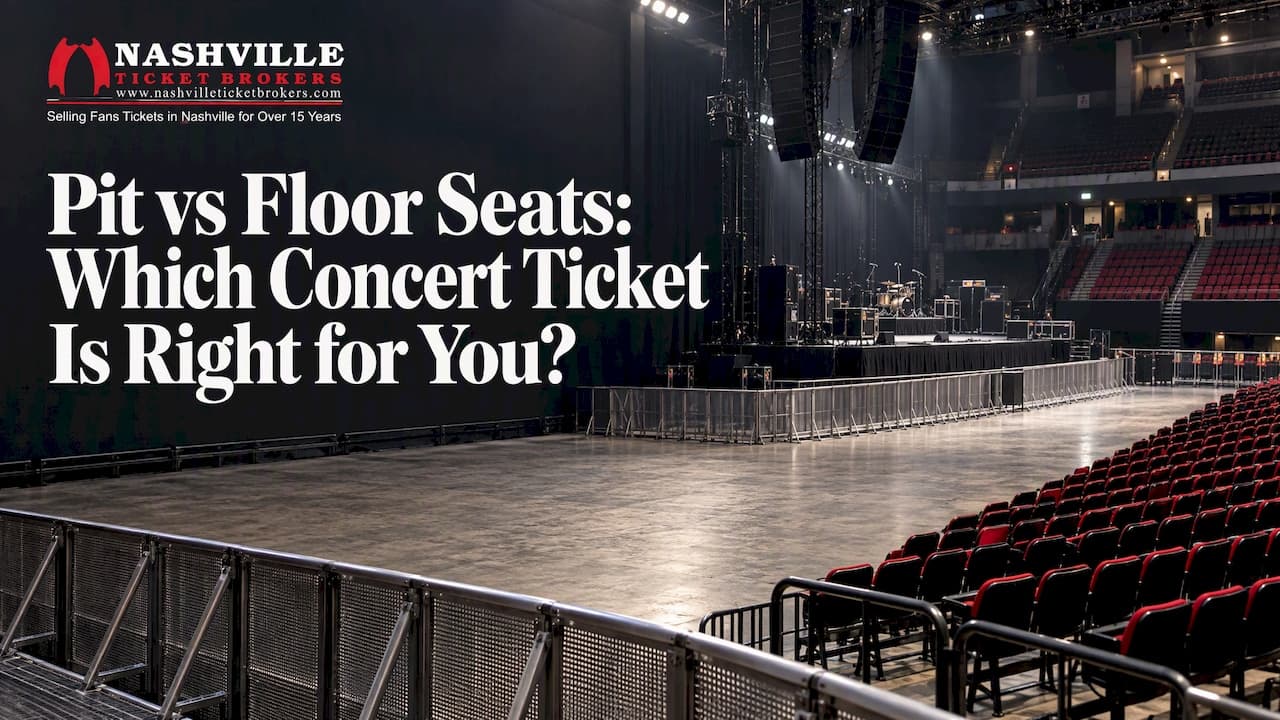
The pit is a standing area right in front of the stage. Floor seats are chairs set up in rows on the arena floor, usually behind the pit or behind the standing section. Pit gets you closer, with a crowd, no guaranteed spot and several hours on your feet. Floor gets you a seat of your own at eye level, and often a better view of the whole production.
That is the short version. The real answer depends on the artist, the venue and how you like to watch a show. Below we break down what each ticket means, what it feels like on the night, how pricing works on the resale market, and how to avoid the most common mistake: buying a "floor" ticket without knowing whether the floor is standing or seated at that show.
TL;DR
- Pit is standing room directly in front of the stage, typically general admission, with your position set by when you arrive and how you move in the crowd.
- Floor seats are assigned chairs on the arena floor. You get a fixed spot, personal space and a place to sit, but a flat floor means tall fans can block your view.
- At some shows the whole floor is general admission standing, so "floor" and "pit" can mean the same thing. Always read the event-specific seating map.
- The price you see first is rarely the price you pay. Check the total at checkout before comparing listings.
- Choose pit for energy and proximity. Choose floor for comfort, a sure spot and a fuller view.
Table of Contents
- What the pit actually is
- What floor seats are
- Pit vs floor seats at a glance
- When "floor" and "pit" mean the same thing
- Pit vs general admission: how they differ
- Which one gives the better view?
- Crowd, comfort and personal space
- Which artists suit the pit and which suit floor seats
- Price: why floor can cost more, or less, than the pit
- How to choose: a quick decision guide
- Before you buy: a short checklist
- Our perspective
- Find your seats
- FAQ
- Sources
What the pit actually is
The pit is the area closest to the stage. According to a ticketing guide to concert pits, it is a standing-room zone that is typically general admission, with no seats, where position is first come, first served. Some artists add a barricade or a separate entrance for pit ticket holders. Others simply mark off the front section of the floor.
In practice that means:
- You stand the whole show. Expect two to four hours including the opening act, unless you leave.
- Your spot is earned. Fans who arrive early tend to claim the front. Fans who arrive late stand further back, even though they hold the same ticket.
- The crowd moves. Singing, jumping, surges toward the stage and people squeezing past for drinks or restrooms are part of the experience.
- Capacity is limited. The pit is usually a fraction of the total floor, so these tickets can sell out first for high-demand artists.
If your idea of a concert is being near the performer, feeling the bass in your chest and being part of a crowd that knows every word, the pit is built for you.
What floor seats are
Floor seats are assigned chairs on the ground level of an arena, set up in rows that extend back from the stage or from the edge of the pit. Because they are reserved, your section, row and seat number are on the ticket. Nobody can take your spot, and you can arrive when you like.
The tradeoff is the flat floor. In a seated floor layout, front-row floor seats are the best in the house, but because everything sits on one level, a tall person in front of you can restrict the view. Rows further back are still decent. They just depend more on who is in front of you.
Floor seats also tend to cost more than most seats elsewhere in the building, since they offer the most direct line to the stage and the production.
Pit vs floor seats at a glance
| Pit | Floor seats | |
|---|---|---|
| Standing or seated | Standing | Seated (reserved chairs) |
| Your spot | First come, first served | Assigned section, row and seat |
| Distance to stage | Closest possible | Close, but behind the pit or at the sides |
| View | Up close, often looking up, can be blocked by crowd | Eye level, can be blocked by people standing in front |
| Personal space | Limited | Moderate |
| Arrival time matters | Yes, a lot | No |
| Best for | High-energy shows, fans who want to be near the stage | Fans who want comfort and a guaranteed place |
| Risk | Tight crowd, long stand | View blocked if the whole row stands |
When "floor" and "pit" mean the same thing
This is where most fans get tripped up. Two situations blur the line:
- General admission floor. For many concerts, the entire floor is standing room with no chairs. Then "floor" tickets are effectively pit tickets, just with a bigger standing zone. The pit may or may not be a separate, pricier section.
- Convertible floors. Venues often switch the floor between standing and reserved seating depending on the show. A Nashville venue's FAQ says its floor changes between standing-room and reserved seating by show, a pattern common across live venues.
So a ticket labeled "floor" can mean a chair at one concert and a spot on bare concrete at the next. A local venue guide advises that seating setups can shift for big sold-out events, and that you should verify the seating map for your specific event before buying.
It is also worth knowing that listings use different words. You may see "pit," "GA pit," "floor GA," "standing floor," "floor reserved" or just a section number. Our guide to checking seat views before you buy walks through how to read a map so none of those labels surprise you.
Pit vs general admission: how they differ
People search for "pit vs general admission" because the two overlap. General admission (GA) describes how a ticket works: there is no assigned seat, and entry is typically first come, first served, with where you stand or sit left up to you. The pit describes where you are: the zone right at the stage.
So a pit ticket is usually a GA ticket, but not every GA ticket is a pit ticket. A GA floor ticket may put you anywhere on the floor behind the pit area. At a small club show, GA means the whole room. At an arena, GA often refers to the floor in front of the stage, while upper levels are reserved.
The practical rule: if the ticket says GA or standing, you will be on your feet and your view depends on when you arrive. If it lists a section, row and seat, you will be seated.

Which one gives the better view?
It depends on what you want to see.
Pit: You see the artist's face, hands and expressions. You also see less of the production, because lighting rigs, video screens and stage design are above and behind you. If you are in the very front, you may spend the night looking steeply upward. If you are in the middle of the pit, your view is whatever the people in front of you allow.
Floor seats: You are set back far enough to see the stage as a whole, and at eye level. Industry writing on floor seating notes it offers a more balanced experience than the crowded pit, with an eye-level view and room to move. The catch is the flat floor. If fans in front of you stand all night, you stand too, and then you are in a lightly assigned version of the pit.

For shows with big screens and elaborate staging, a mid-floor or a raised lower-bowl seat can show you more than the pit does. For intimate acoustic sets, the pit's closeness is the point.
Crowd, comfort and personal space
Be honest about how you handle crowds.
- Pit is physical. You will be bumped. Heat builds. Water access is limited once you commit to a spot. If you need to leave, you lose your place. Fans with mobility limits, young children or a dislike of tight spaces usually do better elsewhere.
- Floor seats give you a home base. You can sit between songs, leave for the restroom and walk back to the same spot. Standing is optional until the crowd decides otherwise.
For first-timers, a seated floor ticket is the easier introduction. For veterans who already know they love the crush, the pit is often worth it.
Which artists suit the pit and which suit floor seats
There is no fixed rule, but genres follow patterns.
- Rock, pop-punk, hard rock and high-energy pop: The pit is the main event. Fans expect to stand and move.
- Country arena shows: Many fans stand for most of a headliner's set, but floors are often fully reserved. That makes floor seats a comfortable pick. Browse our country music tickets to see which setups listed shows use.
- Pop and rock tours: Setups vary a lot by tour. Some set a small pit in front of the stage and chairs behind. Others open the entire floor as GA. Check pop and rock tickets with the seating map open.
- Singer-songwriter, jazz, theater-style shows: Seated floors dominate and the pit rarely exists.
The same logic applies outside music. Our UFC seating guide explains why floor-level seats near the cage are a different choice from the bowl, with different views, sound and cost.
Price: why floor can cost more, or less, than the pit
There is no universal answer to "how much are pit seats?" or "why are floor tickets so cheap?" Face value is set by the artist and promoter, and resale prices move with demand. A few patterns help:
- Seated floor is generally priced at a premium because it offers the most direct view of the stage. That premium is typical of floor seating.
- Standing floor (GA) is often cheaper than a reserved floor seat because there is no assigned spot, and some listings look cheap because they sit far back in a large standing zone.
- A separate pit can be priced above the rest of the GA floor, especially for artists with devoted fans.
- Resale markups vary widely. Premium floor tickets for in-demand shows can sell far above face value. Tickets for lesser-demand dates sometimes sell below it.
One rule applies to every comparison: look at the final price. A local venue guide says the real cost can run 30 to 50 percent above the listed price once service and handling fees are added, so the cheapest-looking ticket is rarely the cheapest at checkout. Compare totals, not the first number you see. For help finding a trustworthy place to buy, read our guide to the most reliable ticket sites.
How to choose: a quick decision guide
Ask yourself five questions.
- Can I stand for three or more hours? If not, pick a seated floor or lower-bowl seat.
- Do I care more about closeness or the full show? Closeness points to the pit. The full show points to floor seats or the lower bowl.
- How tall am I? If you are short, a standing crowd can hide the stage. A raised seat may beat a floor spot.
- Will I arrive early? The pit rewards early arrival. If you will come as the lights go down, a reserved seat protects your spot.
- Who am I going with? Groups usually do better in reserved seats, where everyone stays together. In the pit, groups drift apart.
Before you buy: a short checklist
- Open the event's seating map and confirm whether the floor is standing or seated for this show.
- Look for words like GA, standing, general admission, pit, section, row and seat number.
- Check if there are restrictions, such as a separate pit entrance or a wristband system.
- Compare the all-in price including fees.
- Review the delivery method and the date you will receive tickets.
- Buy from a seller that backs the ticket. Ours comes with a 100% money-back guarantee that tickets arrive before the event and are valid for entry.
Our perspective
We see the same question every time a big tour is announced. Fans ask whether the pit is worth it, and often the more important question is whether they know what they are buying. The most frequent regret we hear about is not choosing the wrong zone. It is assuming "floor" meant a chair when the floor was standing, or the reverse.
So our advice is plain. Decide first how you want to spend the night: on your feet at the rail, or settled with a clear view. Then confirm the layout for that exact show, since layouts change by tour and by date. If you are choosing between two similar listings, pick the one whose seating map you understand best.
Resale is how many fans get into sold-out shows, and it works best when the buyer is informed and protected. That is why we put the guarantee at the center of what we do: tickets that arrive before the event and are valid for entry.
— Capital
Find your seats
Ready to compare? Browse concert tickets on Nashville Ticket Brokers and open the seating map for the show you want. You can also see what is coming up in our guide to upcoming concerts in Nashville. If you plan to see a show at a historic venue, our listings for the Grand Ole Opry are a good place to start.
FAQ
What is the difference between pit and floor seats?
Pit tickets are for a standing area directly in front of the stage, usually general admission. Floor seats are assigned chairs on the arena floor, typically behind the pit or standing section. At some shows the entire floor is standing, so check the seating map for your event.
Are pit tickets better than floor seats?
Not always. The pit puts you closest to the artist, but you stand all night, share tight space and may end up behind a crowd. Floor seats give you a fixed spot, more comfort and often a fuller view of the production. Which is better depends on whether you value closeness or comfort.
Is general admission the same as the pit?
No, but they overlap. General admission describes a ticket with no assigned seat. The pit is the zone at the stage. Pit tickets are usually GA, but a GA floor ticket may place you farther back from the stage.
Why are some floor tickets cheaper than other seats?
Standing floor tickets often cost less than reserved seats because there is no assigned spot, and a far-back position in a large crowd has a weaker view. Demand also matters, since resale prices rise and fall with the show. Compare the total price after fees, not just the listed price.
How do I know if the floor is standing or seated?
Open the event page and look at the seating map and ticket descriptions. Terms like GA, standing or pit mean you will stand. A section, row and seat number means you will be seated. Venues can change the floor layout by show, so confirm it each time.
Sources
- What Is the Pit at a Concert? A Guide to Pit Tickets
- Are Floor Seats Worth It? Find the Best Concert Seat Views
- What is a General Admission ticket and why is a row listed?
- The Pinnacle Nashville: A Local's Complete Venue Guide 2026
- The Truth Frequently Asked Questions
- Bridgestone Arena seating chart guide